
Introduction
Healthcare is undergoing a major transformation as artificial intelligence(AI replace doctors) becomes more deeply integrated into medical practice. From reading medical scans to predicting disease risks AI now performs tasks that were once exclusive to physicians. This rapid advancement has raised an important question for patients professionals and policymakers alike will artificial intelligence remain a supportive tool or will it eventually take over the role of doctors entirely. Understanding this shift is essential as technology continues to reshape modern medicine.
What Is AI in Healthcare
Artificial intelligence in healthcare refers to computer systems designed to learn analyze data and support decision making in ways similar to the human brain but at far greater speed and scale. Instead of relying on memory or intuition AI systems process massive volumes of medical data to detect patterns predict outcomes and recommend treatments.
For example AI can analyze thousands of X rays in seconds and detect tumors with high accuracy even outperforming tired specialists late in long shifts. Medical chatbots answer patient questions about symptoms medications and follow ups while predictive tools identify individuals at high risk for chronic illnesses such as heart disease or diabetes.
AI should be viewed as an advanced assistant rather than an independent decision maker. Just as calculators empowered mathematicians artificial intelligence enhances doctors’ capabilities without replacing human reasoning compassion or ethical judgment.
AI in Healthcare Overview Table
| Aspect | Description |
| Primary Role of AI | Data analysis diagnostics prediction |
| Human Role | Empathy ethics decision making |
| Key Benefits | Speed accuracy access |
| Main Risks | Bias privacy over reliance |
| Future Model | Collaborative hybrid care |
How AI Is Currently Used in Medicine
Diagnostic Imaging and Pattern Recognition
AI excels at recognizing patterns in visual data. In radiology dermatology and pathology AI systems identify subtle abnormalities in MRIs CT scans and skin images. Early signs of lung cancer or diabetic eye disease are often detected sooner through AI assisted analysis.
Virtual Health Assistants and Chatbots
Chatbots and digital assistants support appointment scheduling patient education and symptom assessment. These tools reduce workload for healthcare staff while improving patient access to timely information.
Predictive Analytics for Treatment Planning
Hospitals use AI to forecast patient outcomes by analyzing medical history lab results and lifestyle data. Early risk detection allows clinicians to intervene sooner and improve patient safety.
Robotic Surgery and Automation
AI guided robotic systems enhance surgical precision reduce recovery times and minimize errors. Automation also improves efficiency in laboratories pharmacies and administrative workflows.
Together these applications show that AI is already embedded in healthcare operations supporting better outcomes behind the scenes.
Also Check: AI ROI for Small Business Growth and Performance
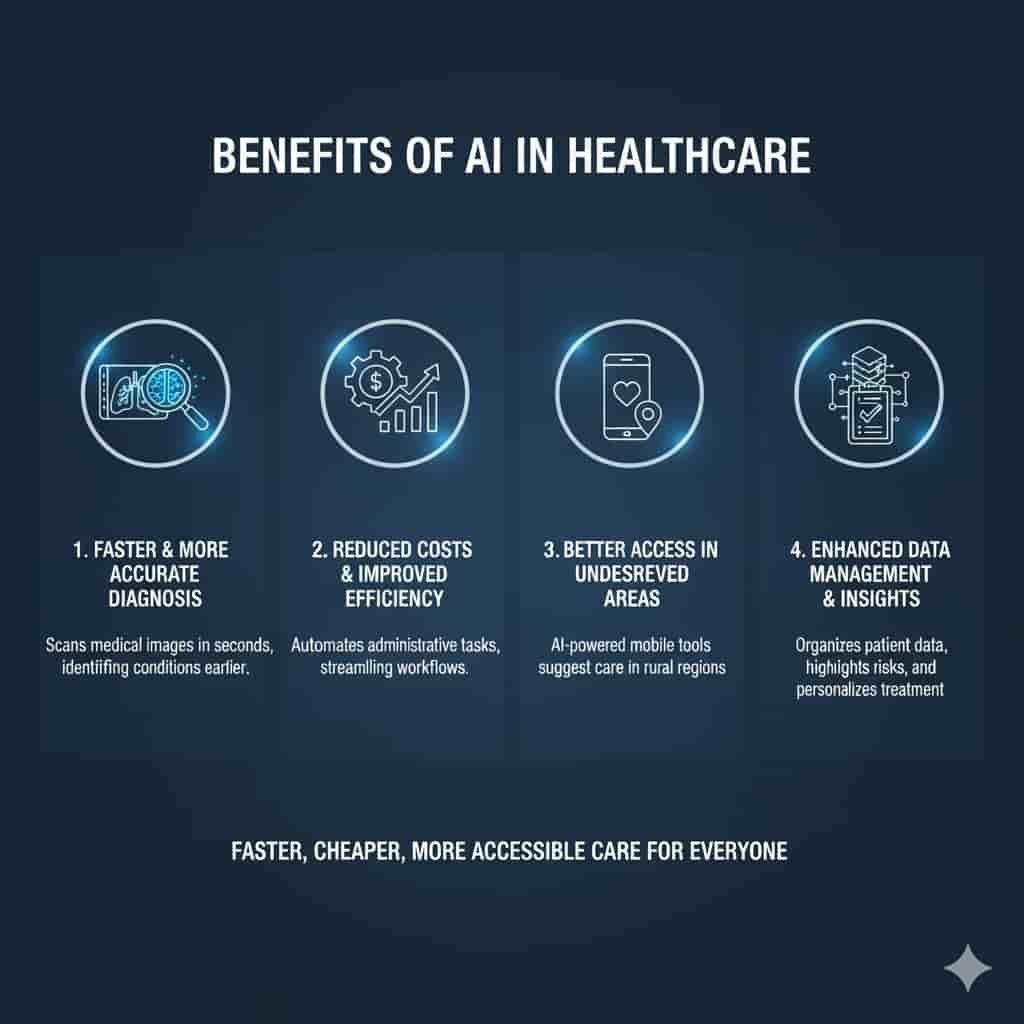
Benefits of AI in Healthcare
Faster and More Accurate Diagnosis
AI processes data rapidly allowing earlier detection of serious conditions. Faster diagnosis can significantly improve survival rates.
Reduced Costs and Improved Efficiency
By automating administrative and repetitive tasks AI lowers operational costs and allows doctors to focus on patient care rather than paperwork.
Better Access in Underserved Areas
AI powered mobile tools support patients in rural or low income regions where doctors are scarce by providing basic evaluations and guidance.
Enhanced Data Management and Insights
AI organizes complex patient records highlights risks and assists in creating personalized treatment plans improving clinical decision making.
These benefits explain why many believe AI replace doctors debates are gaining momentum across the medical community.
Limitations of AI in Healthcare
Lack of Empathy and Human Connection
AI cannot provide emotional support reassurance or empathy. Human interaction remains central to healing and trust.
Ethical and Privacy Concerns
AI relies on sensitive patient data raising concerns about ownership security and misuse.
Risk of Errors and Over Reliance
AI systems can make mistakes. Blindly following algorithmic recommendations without clinical judgment can be dangerous.
High Implementation Costs
Deploying AI requires significant investment in infrastructure training and maintenance which smaller hospitals may struggle to afford.
These challenges reinforce that technology alone cannot solve every healthcare problem.
Will AI Replace Doctors or Assist Them
The debate over whether AI replace doctors centers on two opposing perspectives.
Supporters of replacement argue that machines outperform humans in data processing diagnostics and risk prediction. AI does not suffer from fatigue or bias which could reduce errors in certain tasks.
However the argument for assistance is stronger. Medicine involves ethical judgment empathy communication and trust. Doctors interpret AI outputs through the lens of patient values emotions and real life circumstances. These human qualities cannot be replicated by machines.
Most experts agree the future lies in collaboration rather than replacement. Similar to pilots using autopilot systems doctors will rely on AI while maintaining final authority and responsibility.
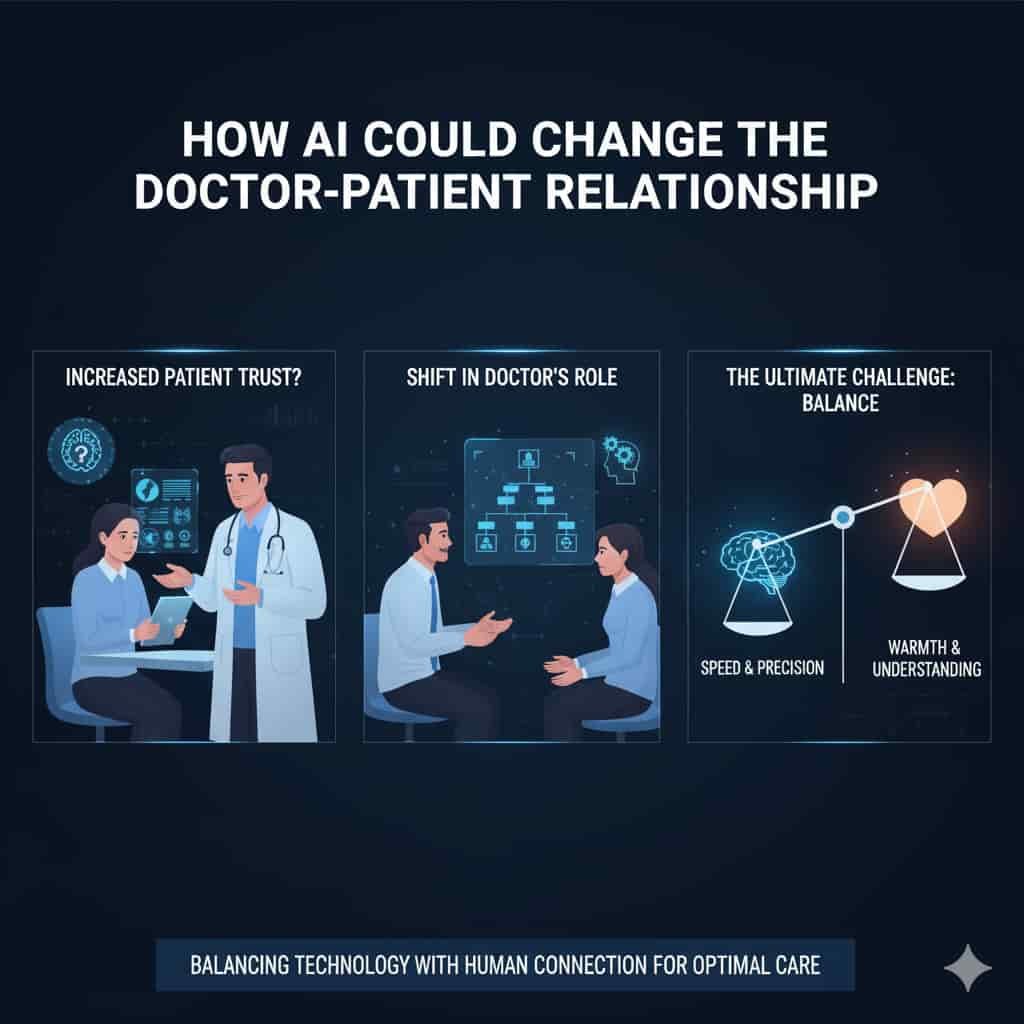
How AI Could Change the Doctor Patient Relationship
As AI enters examination rooms the doctor patient relationship will evolve. Patients may increasingly trust AI recommendations which could challenge traditional authority if opinions differ.
Doctors may spend less time diagnosing and more time guiding patients through choices discussing risks and providing emotional support. This shift could strengthen relationships if technology is used thoughtfully but risks depersonalization if poorly implemented.
Striking a balance between efficiency and empathy will define the success of AI in clinical care.
Ethical and Legal Challenges
Accountability in Misdiagnosis
Determining responsibility when AI errors occur remains legally unclear involving doctors hospitals and software developers.
Patient Data Security
Protecting health data from breaches is essential to maintaining trust in AI systems.
Bias and Fairness
If training data lacks diversity AI may produce biased outcomes. Ensuring fairness is critical for safe deployment.
Until these issues are resolved concerns around AI replace doctors narratives will persist.
Tech 2 Innovation Role:
Tech2innovation presents this discussion with clarity by breaking down both the technological and human sides of artificial intelligence in healthcare. This post on tech2innovation goes beyond surface predictions by examining real applications ethical concerns and future collaboration models. Unlike many articles that focus solely on automation this analysis emphasizes patient trust empathy and accountability. Tech2innovation highlights how AI reshapes medical roles rather than eliminating them. By combining balanced insight with accessible explanations the platform helps readers understand what AI truly means for doctors and patients. This perspective positions tech2innovation as a reliable source for responsible technology discourse.
What the Future of Medicine May Look Like
The future of medicine is likely to feature hybrid care models where AI handles data analysis while doctors focus on communication and ethics. Remote care will expand personalized treatment plans will become common and clinical workflows will grow more efficient.
Doctors will remain essential though their roles may evolve. While AI enhances precision and speed the heart of medicine will remain human.
Ultimately the question is not whether AI replace doctors but how doctors and artificial intelligence will work together to deliver better care.
Follow our Social Media: Tech 2 Innovation (@Tech2Innovate) / X
Pingback: AI Adoption in Change Management Strategies for Sustainable Growth